
There are 7 passive income ideas Pakistan investors actually use to build real wealth — and the one you are probably chasing right now is almost certainly not on this list. Roughly 2.4 million Pakistanis search for passive income ideas Pakistan every year, and an estimated 96% of them are still working the same job, at the same salary, twelve months later. This is not a motivation problem. This is a mental model problem. The advice circulating in Pakistani WhatsApp groups and YouTube thumbnails has been copied so many times from Western sources that it has completely lost contact with Pakistani economic reality: 20%+ inflation, a depreciating rupee, thin capital markets, and an online gig economy that rewards patience — not shortcuts.
If you have tried to build passive income and failed — or never started because nothing felt right — this article is the honest conversation nobody in Pakistan’s personal finance space is willing to have.
5 Hidden Truths About Passive Income Ideas Pakistan Nobody Admits
Truth 1: “Passive” Is a Reward for Past Active Work — Not an Alternative to It
Most people think passive income means income without effort. Reality is that every legitimate passive income idea in Pakistan is simply deferred compensation for effort already spent — and the deferral period is almost always longer than the internet suggests. A dividend portfolio paying PKR 40,000/month required years of capital accumulation. A digital product selling while you sleep required months of creation. The word “passive” describes the maintenance phase, not the building phase — and most people quit during the building phase.
Truth 2: Pakistan’s Inflation Destroys Fixed Passive Income Faster Than Anywhere
Most people think earning PKR 25,000/month passively equals financial progress. Reality is that Pakistan’s average inflation between 2020–2024 ran at approximately 22% annually. According to the State Bank of Pakistan’s monetary policy reports, CPI inflation peaked at 38% in May 2023. A fixed PKR income stream of PKR 30,000/month loses half its purchasing power in roughly three years at this rate.
Passive income ideas Pakistan that do not grow faster than inflation are not building freedom — they are building a slower version of poverty. This is the truth no passive income influencer discusses because it makes the dream feel harder.
Truth 3: The PSX Has Been Pakistan’s Best-Kept Passive Income Secret for a Decade
Most people think the Pakistan Stock Exchange is for speculators. Reality is that the KSE-100 delivered average annual returns of 15–22% nominally over the past decade, with high-dividend sectors — banking, cement, energy — paying yields of 7–14%. According to the Securities and Exchange Commission of Pakistan (SECP), fewer than 800,000 Pakistanis hold active brokerage accounts — less than 0.35% of the population.
The investor who dismisses stocks as “risky” while leaving money in a savings account earning 10–12% against 20%+ inflation is not avoiding risk. They are choosing a different, quieter kind of loss.
Truth 4: Making Money Online in Pakistan Is a Business — Not a Button
Most people think how to make money online in Pakistan means setting up a system once and watching income arrive. Reality is that every Pakistani who earns consistently online runs a real business — with marketing, quality control, and client retention. The State Bank of Pakistan recorded over USD 397 million in freelance remittances in FY2023. That money did not arrive passively. It arrived because Pakistanis built real skills and delivered real value, consistently, over years.
Truth 5: Financial Freedom in Pakistan Requires a Dollar Anchor
Most people think financial freedom Pakistan means earning enough rupees to cover rupee expenses. Reality is that wealth built entirely in PKR is structurally fragile — the rupee has lost approximately 75% of its value against the USD over the last ten years. Every intelligent wealth-building strategy today includes at least one USD-linked income or asset. Without a dollar anchor, you are building on a foundation that is slowly sinking beneath you.
First Principles: What Passive Income Ideas Pakistan Actually Require
Strip away the marketing language and every passive income stream reduces to three fundamental inputs:
- Capital × Return Rate. Deploy money into an asset generating returns. At 18% annual return, PKR 1 million earns PKR 180,000/year — PKR 15,000/month. The math is simple. The difficulty is accumulating the capital first. This is where PSX dividend stocks, mutual funds, and government securities live.
- Audience × Conversion Rate. Build an audience of people who trust you, then convert a percentage into paying customers. An email list of 5,000 Pakistani subscribers at 2% conversion with a PKR 3,000 product generates PKR 300,000 per launch. Income here scales with trust, not hours.
- Skill × Systematisation. Master a high-value skill, then build systems — templates, processes, automation — that allow the skill to generate income without your direct involvement in every transaction. This is how online income transitions from active to genuinely passive.
The reason most Pakistanis fail to build passive income is not that they lack the right idea. It is that they jump across all three categories simultaneously, achieve depth in none, and mistake activity for progress.
Passive Income Ideas Pakistan: Honest Comparison Table
Before choosing any passive income approach, compare these eight options against the only metrics that matter in Pakistan’s high-inflation environment:
| Income Stream | Min. Entry | Time to Income | Monthly Range (PKR) | Inflation Resistant? | Ongoing Effort | Verdict |
|---|---|---|---|---|---|---|
| PSX Dividend Stocks | PKR 50,000+ | 3–6 months | 5,000–200,000+ | Yes (if reinvested) | Low | ★★★★★ Best long-term |
| Equity Mutual Funds | PKR 1,000/month | 3–5 yr compounding | Reinvest phase first | Yes | Very Low | ★★★★★ Best entry point |
| T-Bills / PIBs | PKR 100,000+ | At maturity | 8,000–80,000 | No — fixed nominal | Minimal | ★★★ Short-term only |
| Rental Property | PKR 5–30 million | Immediate | 15,000–200,000 | Partially | Medium | ★★★ Illiquid, overrated |
| Freelancing → Productised | Near zero | 3–12 months | 40,000–600,000 | Yes (USD-linked) | Medium | ★★★★★ Best for professionals |
| YouTube / Content | PKR 30,000–80,000 | 12–24 months | 5,000–300,000+ | Platform-dependent | High (ongoing) | ★★★ Not truly passive |
| Digital Products | PKR 10,000–50,000 | 6–18 months | 10,000–300,000 | Yes | Low after creation | ★★★★ Most underused |
| Savings Accounts / Prize Bonds | Any amount | Immediate | Negligible real return | No — losing to inflation | Zero | ★ Quiet wealth destruction |
3 Named Frameworks to Build Passive Income Ideas in Pakistan
Framework 1: The Capital Threshold Rule
If your investable capital is below PKR 500,000, do not prioritise investment-based passive income yet. Below this threshold, returns are too small to be motivating — PKR 500,000 at 15% = PKR 6,250/month — and the opportunity cost of not building a digital skill is enormous. The correct sequence: build a skill earning in dollars first → accumulate PKR 500,000–1,000,000 → then deploy aggressively into PSX equities and mutual funds. Reversing this sequence is the single most common mistake young Pakistani professionals make when pursuing passive income ideas.
Framework 2: The Dollar Anchor Rule
Every Pakistani passive income architecture must include at least one USD-denominated component. This does not require emigration. It requires one income stream — freelancing, international digital product sales, or foreign equity exposure — that earns or grows in dollars. One USD-earning stream functions as a structural hedge against PKR depreciation. Pakistani investors who achieved genuine financial freedom in the 2015–2025 decade almost universally had a dollar anchor, even if it was only 20–30% of total income.
Framework 3: The One-Then-Layer Rule
Build one passive income stream to PKR 20,000/month consistently for three consecutive months before beginning a second. Most Pakistanis chasing passive income ideas never sustain any single stream long enough to cross into profitability — they switch ideas at the 60% mark, collecting partially-built systems that generate nothing. The One-Then-Layer Rule forces completion. Your second stream then gets funded by the first — creating momentum that is both financially and psychologically self-reinforcing.
If the Capital Threshold Rule resonated and you are ready to deploy capital into PSX equities instead of just reading about it — Hawks Global makes this the easiest step you will take this year. Open a brokerage account today, or start with the Starter Investment Programme at just PKR 5,000: professionally guided, built specifically for Pakistani investors who are serious about building real wealth. Open your account here or message us on WhatsApp — our team responds same day.
Where Pakistani Financial Advice on Passive Income Gets It Dangerously Wrong
The most dangerous belief in Pakistani personal finance today is not that stocks are risky. The most dangerous belief is: “Buy property. It never loses value.”
Here is the calculation nobody shows you: a property purchased for PKR 10 million in 2015 “worth” PKR 22 million today appears to show a 120% gain. But the rupee lost approximately 72% of its value against the USD in that same period. In dollar terms, that property went from USD 100,000 to USD 78,000. You did not gain wealth. You preserved it partially — while enduring illiquidity, maintenance costs, tenant risk, and zero compounding.
Compare this to a diversified KSE-100 portfolio in the same period: the index moved from roughly 32,000 to over 100,000 points — a 212% nominal gain, with dividends on top, in a liquid, divisible, low-friction asset. The second-order consequence of Pakistan’s property obsession is that national capital has been locked in non-compounding assets while the equity market went largely uninvested by the people who needed it most.
The second dangerous belief: “A savings account is safe.” At 10–12% profit rates against 20%+ inflation, a savings account is not a safe harbour. It returns a nominal positive while delivering a real negative — with the reassuring packaging of a bank statement. How to invest money in Pakistan begins with understanding that the biggest risk is not market volatility. It is losing purchasing power to time — slowly, invisibly, politely.
How Passive Income Compounds Over 10 Years: A PKR Scenario
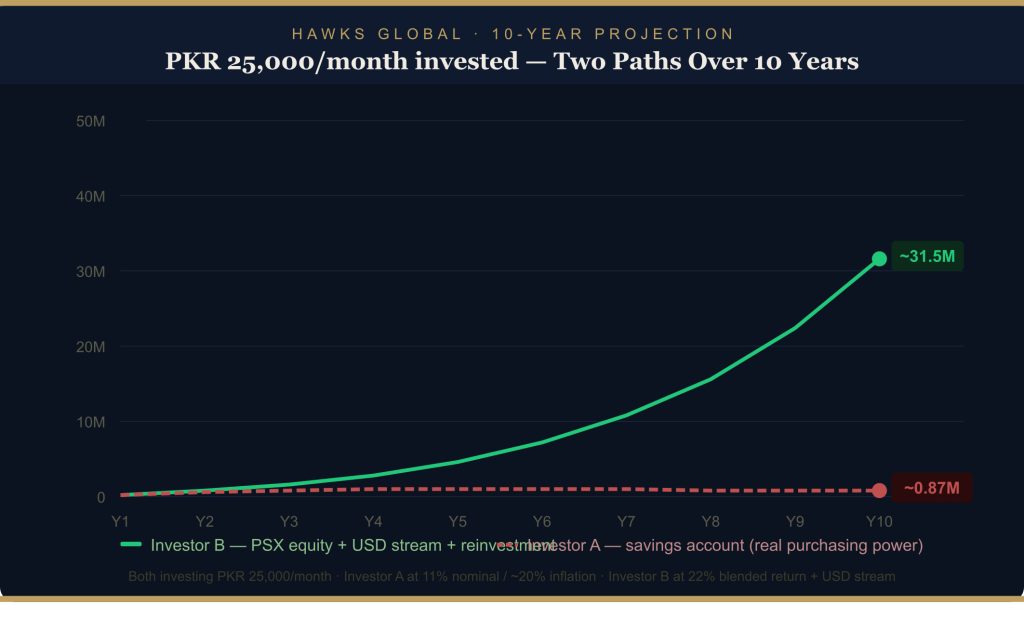
Two Pakistani professionals — both 30 years old, both earning PKR 180,000/month, both serious about financial freedom Pakistan.
Investor A — The Conventional Path: Saves PKR 25,000/month in a bank savings account at 11% annually. After ten years: approximately PKR 5.3 million nominally. Adjusted for 20% average inflation, real purchasing power equals roughly PKR 870,000 in today’s money. A decade of discipline. Almost no real wealth movement.
Investor B — The Architect Path: Deploys the same PKR 25,000/month: PKR 12,000 into a diversified PSX equity portfolio (targeting 20–25% annual returns); PKR 8,000 into building a productised freelance skill earning USD 200–400/month by year two; PKR 5,000 auto-reinvested into dividend stocks at every payout. By year five: PKR 45,000–65,000/month in investment income. By year ten: the compounding machine exceeds his original salary in real purchasing power terms.
The gap is not intelligence or discipline. It is financial architecture — the deliberate, sequenced design of how to invest money in Pakistan in a high-inflation, depreciating-currency environment where Western personal finance rules simply do not apply.
3 Mental Models for Building Passive Income Ideas in Pakistan
Mental Model 1: The Income Illusion Cycle
Income rises → lifestyle expands to absorb it → financial position feels identical → income must rise again to feel better → repeat indefinitely. This is why professionals earning PKR 300,000/month feel as financially anxious as those earning PKR 80,000. Breaking it requires one rule: every time income increases, 70–80% of that increase goes to investment before lifestyle adjusts. This single discipline is the mechanism that converts earned income into passive income that compounds — at any income level.
Mental Model 2: The Delayed Wealth Trap
Waiting until conditions are “right” to begin — until the rupee stabilises, the market corrects, income increases — is the Delayed Wealth Trap. Conditions in Pakistan will rarely feel ideal. The investor who starts with PKR 3,000/month at age 25 will almost universally outperform the investor who starts with PKR 30,000/month at age 35 — because compounding rewards time above all else. Starting small is not a consolation prize. It is the actual strategy.
Mental Model 3: The Asymmetric Return Filter
Before any passive income commitment, ask: what is the realistic worst case versus the realistic best case — and what is the ratio? Savings account: worst = real loss of 8–12%/year, best = marginally positive. PSX equity mutual fund over five years: worst = 10–15% drawdown one year, best = 25–35% annual return with dividends. Productised freelance skill: worst = three to six months near-zero income, best = USD income compounding indefinitely. The asymmetry is obvious once you see it. Most Pakistanis choose the option with the worst asymmetry — not because it is genuinely safer, but because it feels safer. That feeling is costing them years.
FAQ: Passive Income Ideas Pakistan — Questions Pakistanis Actually Search
Pakistan mein passive income kaise banayein — koi experience ya capital nahi?
Start two parallel tracks simultaneously. First, open an equity mutual fund account — SECP-regulated asset management companies allow investments from PKR 1,000/month with no prior experience required. Second, identify one digital skill you can learn in 60–90 days and monetise internationally: graphic design, content writing, video editing, or web development. Build the skill, earn in dollars, deploy those dollars into your investment account. Neither track is passive in month one — both can be meaningfully passive by year three.
What are the best passive income ideas in Pakistan for someone with PKR 5 lakh?
At PKR 500,000, the most effective deployment is a split between high-dividend PSX equities (60%) and an equity mutual fund with automatic reinvestment (40%). At a blended 18–22% annual return, this generates approximately PKR 90,000–110,000/year, or PKR 7,500–9,000/month. The key is patience — do not withdraw returns for at least three years. Let the machine build itself before you draw income from it.
How to make money online Pakistan — kya ye actually possible hai?
Yes — and verified by data. Pakistan’s IT and freelance exports crossed USD 2.6 billion in FY2023. Platforms like Upwork, Fiverr, Toptal, and LinkedIn have enabled thousands of Pakistanis across the country to build USD-earning income streams. The realistic timeline to PKR 50,000–80,000/month equivalent in online income is 12–24 months of focused, professional effort. Those who succeed treat it as their most important business from month one — not as a side experiment.
Kitna paisa chahiye PKR 50,000 per month passive income ke liye?
At a conservative blended yield of 8–10% annually from PSX equities, generating PKR 50,000/month requires approximately PKR 6–7.5 million in deployed capital. This is achievable over 10–14 years of PKR 20,000–25,000/month disciplined investment if returns average 20%+ annually — which PSX has historically delivered in nominal terms. The calculation becomes significantly more achievable when combined with a USD-earning stream that accelerates capital accumulation in the first five years.
Is PSX safe for passive income — ya ye sirf ameer logon ke liye hai?
The KSE-100 has delivered approximately 15–20% average annual returns over the last decade, outperforming inflation in most years. The risk of PSX investing has been dramatically overstated in Pakistani financial culture — partly because the banking sector profits from keeping Pakistani savings in low-yield deposits. The correct approach is not speculation: it is a diversified portfolio of fundamentally strong, dividend-paying companies held for five or more years. This approach has historically delivered superior real returns compared to savings accounts and prize bonds — for investors at every capital level.
The most expensive financial decision most Pakistanis will ever make is not a bad investment — it is the decision to keep learning about investing without ever actually investing, year after year, while inflation quietly does the compounding that discipline refused to.