
Let me tell you something that will genuinely shock you.
In Pakistan, a non-filer buying a car worth Rs. 15 lakh pays Rs. 30,000 in registration tax. A filer buying the exact same car pays Rs. 10,000. Same car. Same showroom. Same day. The only difference is a single hour spent filing a tax return.
Learning how to file tax return in Pakistan could save you Rs. 20,000 on a single car purchase — and that is just the beginning.Now multiply that across property purchases, bank withdrawals, dividends, prize bonds, and a dozen other daily financial activities — and you start to understand why learning how to file tax return in Pakistan is one of the most financially impactful things you can do in 2026.
This guide is written for the person who has been meaning to file for years but kept putting it off because it seemed complicated. I promise you — it is not as hard as you think. And by the time you finish reading this, you will have everything you need to do it yourself.
Why Filing Your Tax Return in Pakistan Matters More Than Ever in 2026
Before we get into the how, let us talk about the why — because most people do not fully understand what they are actually losing by not filing.
The government of Pakistan has been aggressively tightening the gap between filers and non-filers since 2023. Every Finance Act has made non-filer status more expensive. In 2025-2026, the difference has reached a point where staying a non-filer is genuinely costing you serious money on almost every major financial transaction you make.
| Transaction | Filer Tax Rate | Non-Filer Tax Rate | Money You Lose |
|---|---|---|---|
| Cash withdrawal above Rs. 50,000/day | 0.3% | 0.6% | Double |
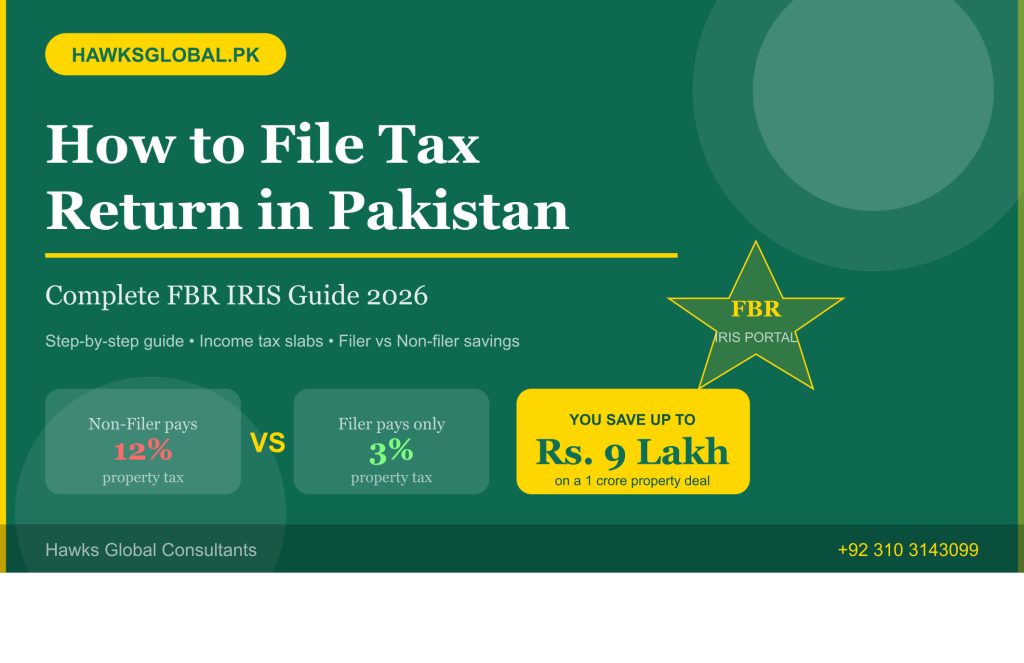
| Property purchase (advance tax) | 3% | 12% | 4x more |
| Vehicle registration (1000cc car) | Rs. 10,000 | Rs. 30,000 | Rs. 20,000 extra |
| Dividend income tax | 15% | Higher slab rates | Significant |
| Prize bond winnings | 15% | 25%+ | 10%+ more |
For someone buying a Rs. 1 crore property, the advance tax difference alone between a filer and non-filer is over Rs. 9 lakh. Nine lakh rupees. For one transaction. That is more than most people earn in six months.
Beyond money, filer status gives you something just as valuable — financial credibility. Banks treat filers differently for loans. Visa applications go smoother. Business dealings become cleaner. Your entire financial identity is stronger when you are on the FBR Active Taxpayer List.
💡 Important: Even if your income is below the taxable threshold of Rs. 600,000 annually, you can and should still file a return. Being a filer costs you nothing — but saves you thousands on every major transaction.
Who Must File a Tax Return in Pakistan?
You are legally required to file an income tax return in Pakistan if any of these apply to you. Check honestly — most people qualify and do not know it.
Salaried individuals earning more than Rs. 600,000 per year — that is Rs. 50,000 per month. If your salary crosses this, filing is mandatory, not optional.
Business owners of any size — whether you run a small shop, a restaurant, a consultancy, or a trading business. If you are generating income from business activity, you must file.
Freelancers earning through Upwork, Fiverr, Toptal, or any other platform. This is one of the most misunderstood areas. Freelancer income from foreign clients is taxable in Pakistan and FBR has been specifically tightening rules on this in 2025. A new regulation (SRO 1561-I/2025) was issued specifically addressing digital income earners.
Property owners with assets worth Rs. 5 million or more. If you own property or significant assets, FBR requires wealth declaration annually.
Investors in stocks, mutual funds, or real estate who earned dividends, capital gains, or rental income during the year.
And even if you fall below all these thresholds — even if you are a student, a housewife, a young professional just starting out — voluntarily filing is still smart. It costs nothing, takes under an hour, and immediately starts building your filer credentials for every future transaction.
What You Need Before You Start — Documents Checklist
Do not sit down at the IRIS portal without these ready. Missing one document halfway through is what causes people to abandon the process. Gather all of this first — it takes 15 minutes and makes everything after smooth.
Your CNIC number — this is now your NTN (National Tax Number). Pakistan unified both in 2015. Your CNIC is your tax identity.
Your mobile number registered in your name — IRIS sends verification codes to this number. If your SIM is in someone else’s name, you will need to fix that first.
Salary certificate or pay slips — your employer gives this. It shows gross salary, any tax already deducted (withholding tax), and allowances. Ask your HR or accounts department. They are legally required to provide it.
Bank statements for the tax year — July 2024 to June 2025 for Tax Year 2025. You need to show income received and any tax deducted by the bank on your savings profit.
Utility bills in your name — electricity, gas, water. These are used for address verification in your wealth statement.
Property documents if you own any — purchase deeds, registration papers, current estimated value.
Vehicle registration if you own a vehicle — make, model, year, and registration number.
Withholding tax certificates — from your bank, employer, or any institution that deducted tax on your behalf. These are critical because you can claim this deducted tax back against your final liability.
How to File Tax Return in Pakistan — Step by Step on FBR IRIS
The FBR IRIS portal is at iris.fbr.gov.pk. This is the only official platform. Do not use any other website or app claiming to file your taxes — use IRIS directly.
Step 1 — Register on IRIS (First Time Only)
If you have never filed before, go to IRIS and click Registration. Enter your CNIC number and the mobile number registered in your name. IRIS will send you a verification code. Enter it, create a password, and your account is ready. Your NTN is your CNIC number — no separate application needed.
If you already have an account from previous years, simply log in with your CNIC and password. If you forgot your password, use the Forgot Password option — it resets via your registered mobile number.
Step 2 — Navigate to Your Income Tax Return
Once logged in, look at the top menu and click Declaration. From the dropdown, click Returns/Statements (Original). Then select Normal Return (Ind/AOP/Coy). Enter 2025 as your Tax Year and select 01-JUL-2024 to 30-JUN-2025 from the options. Click Continue. This opens Form 114(1) — your income tax return form.
Step 3 — Fill in Your Personal Information
The first tab is Personal Info. Much of this will be pre-filled from your CNIC data. Check every field carefully — especially your address and residency status. You will be asked whether you were present in Pakistan for 183 days or more between July 2024 and June 2025. For most Pakistanis living and working in Pakistan, the answer is Yes.
Step 4 — Enter Your Income Details
This is the most important section. Click the Employment tab if you are salaried. Enter your gross salary, any allowances, transport monetization benefit if applicable, and the withholding tax your employer already deducted. Your salary certificate from your employer has all these numbers. Enter them exactly as they appear — do not round up or estimate.
If you have other income sources — rent, dividends, bank profit, freelance income — click the relevant tabs and enter each one. IRIS has separate sections for each income type. Do not skip any source of income, even if it seems small. Incomplete declarations cause audit triggers later.
Step 5 — Claim Your Deductions and Tax Credits
This is where most people leave money on the table. Click the Tax Credits and Deductions tab. Here you can claim back withholding taxes already deducted by your bank, employer, utility companies, and others. Every rupee of withholding tax shown on your certificates should be entered here — it reduces your final tax liability directly.
You can also claim deductions for donations to approved charities, contributions to pension funds, and education expenses in some cases. If you are unsure about specific deductions, consult a tax professional — the savings are often significant.
Step 6 — File Your Wealth Statement
This is the step that causes the most confusion and anxiety — but it is simpler than it sounds. The wealth statement is just a declaration of everything you own and owe. Assets: property, vehicles, cash, investments, gold, bank balances. Liabilities: loans, mortgages, outstanding amounts. IRIS will not let you submit your tax return unless your wealth statement reconciles — meaning the difference between last year’s wealth and this year’s wealth must match your income minus your expenses. If you earned Rs. 10 lakh and spent Rs. 7 lakh, your net worth should have increased by approximately Rs. 3 lakh.
Step 7 — Pay Any Outstanding Tax
After entering all income and deductions, IRIS automatically calculates whether you owe any additional tax or are entitled to a refund. If tax is payable, IRIS generates a payment voucher called a PSID (Payment Slip ID). You can pay this online through your bank’s internet banking, or at any designated bank branch. Keep the payment confirmation safe.
Step 8 — Submit and Download Your Acknowledgment
Review everything one final time. When you are confident it is correct, click Submit. IRIS will generate an acknowledgment receipt. Download this PDF immediately and save it somewhere safe — Google Drive, your email, wherever you will find it later. This receipt is your proof of filing. You will need it for property transactions, vehicle registration, visa applications, bank loans, and a dozen other situations.
Your name will appear on the FBR Active Taxpayer List within 7 to 14 days of filing.
The Tax Deadline — Do Not Miss This
The official deadline to file your income tax return in Pakistan is September 30 every year. For Tax Year 2025 (covering July 2024 to June 2025), the deadline was September 30, 2025. For Tax Year 2026, the deadline will be September 30, 2026.
FBR has historically granted extensions in some years, but experts now strongly advise against relying on extensions. The FBR has been explicitly reducing extension windows to push people toward timely compliance. File early — the portal is much less congested in July and August compared to the September rush when it frequently slows down or crashes under load.
If you missed the deadline, you can still file as a late filer by paying an ATL surcharge of Rs. 1,000 for individuals. This gets your name on the Active Taxpayer List even after the deadline. Better late than never — and significantly better than remaining a non-filer permanently.
Income Tax Slabs Pakistan 2026 — How Much Tax Do You Actually Owe?
Many people avoid filing because they are afraid of how much tax they will have to pay. The reality is that the majority of salaried Pakistanis either owe very little tax or are entitled to a refund because their employer already deducted too much.
Here are the current income tax slabs for salaried individuals in Pakistan for Tax Year 2026:
| Annual Income | Tax Rate | Monthly Salary Range |
|---|---|---|
| Up to Rs. 600,000 | 0% — Zero tax | Up to Rs. 50,000/month |
| Rs. 600,001 to Rs. 1,200,000 | 5% on amount above 600K | Rs. 50,000 to Rs. 100,000 |
| Rs. 1,200,001 to Rs. 2,200,000 | Rs. 30,000 + 15% above 1.2M | Rs. 100,000 to Rs. 183,000 |
| Rs. 2,200,001 to Rs. 3,200,000 | Rs. 180,000 + 25% above 2.2M | Rs. 183,000 to Rs. 267,000 |
| Rs. 3,200,001 to Rs. 4,100,000 | Rs. 430,000 + 30% above 3.2M | Rs. 267,000 to Rs. 342,000 |
| Above Rs. 4,100,000 | Rs. 700,000 + 35% above 4.1M | Above Rs. 342,000 |
If your annual income is Rs. 600,000 or below — you owe zero income tax. But you should still file. Because filer status saves you money on every other transaction regardless of your income level.
The Mistakes That Get People Into Trouble With FBR
I have helped hundreds of clients file their taxes and fix problems caused by common errors. Here are the ones I see most often — learn from others so you do not repeat them.
Not reconciling the wealth statement. This is the number one reason returns get stuck. If your declared income does not explain your asset growth, IRIS will not let you submit. Work through this carefully — if your net worth went up by more than your declared income, you need to explain where the additional money came from.
Forgetting bank withholding tax certificates. Your bank deducts tax on savings account profit every six months. This is withholding tax that you are entitled to claim back. Many people forget to include it and end up paying more than they owe.
Not declaring all assets. Some people declare their main property but forget a second plot, a car in a family member’s name, or gold jewellery. FBR cross-references data from property registries, MTMIS (vehicle database), and bank records. Undeclared assets trigger notices and audits.
Waiting until the last day. The IRIS portal slows significantly in late September as millions of people file simultaneously. Start in July or August — the process is faster, the portal is stable, and you have time to fix any issues without panic.
Filing only once and stopping. Many people file one year, get their filer status, then stop. Missing three consecutive returns can result in removal from the ATL and reclassification as inactive. File every year without fail — it takes less than an hour once you know the process.
Freelancers and Self-Employed — Your Special Filing Guide
Freelancers are one of the fastest-growing segments of Pakistan’s economy — and one of the most confused when it comes to tax filing. Let me clear this up simply.
If you earn money through Upwork, Fiverr, Freelancer, YouTube monetization, or any other digital platform — that income is taxable in Pakistan. FBR issued specific regulations in August 2025 (SRO 1561-I/2025) specifically covering digital income earners. The government is tracking this income more closely than ever before.
The good news: foreign remittances received through banking channels (your bank account, Payoneer linked to your Pakistani bank, Wise transfers) qualify for significant tax exemptions. This is one of the most valuable benefits for freelancers — income remitted through proper banking channels gets favorable tax treatment. But you must file to claim this benefit.
For freelancers, the filing process uses the same IRIS portal. Under Income section, select Business Income and enter your foreign earnings as professional income. Keep your bank statements showing all remittances as your documentation.
Should You Hire a Tax Consultant or File Yourself?
This depends on your situation. Here is the honest answer:
File yourself if you are a straightforward salaried person with one employer, one bank account, and no property or business income. The process on IRIS takes about 45 minutes to one hour once you have your documents ready. There is no reason to pay someone for this.
Hire a professional if you have multiple income sources, own property or significant assets, run a business, have overseas income, missed multiple years of filing, or received a notice from FBR. In these situations, the cost of a professional is minimal compared to the tax savings and penalties avoided.
At Hawks Global Consultants, we handle FBR tax filing for individuals, salaried professionals, investors, and business owners across Pakistan. We also specialize in helping overseas Pakistanis sort out their tax status efficiently. If your situation is complex or you simply want it done right the first time, contact us for a clean, stress-free filing experience. For our broader investment services, see our guide to how to invest in Pakistan Stock Exchange and our tax filing guide specifically for PSX investors.
The Bottom Line — File This Year, Thank Yourself Next Year
Every person reading this who is not currently a filer is paying more than they should on every major financial transaction in their life. Property deals, car purchases, bank transactions, dividends, prize bonds — the list of places where non-filers pay double is long and growing every year.
Filing your tax return costs you nothing if you owe no tax. It takes under one hour. And it immediately starts saving you money on every major transaction for the next twelve months.
The best time to file was last year. The second best time is right now — before September 30, 2026.
If you want professional help filing your tax return in Pakistan — whether you are a salaried individual, freelancer, investor, or business owner — contact Hawks Global Consultants on WhatsApp. We handle the entire process for you efficiently and affordably.
How do I file my income tax return in Pakistan online?
File your income tax return at iris.fbr.gov.pk — FBR’s official IRIS portal. Register using your CNIC and mobile number, log in, go to Declaration → Returns/Statements, select Normal Return, choose Tax Year 2025, and fill in your income, deductions, and wealth statement. Submit and download your acknowledgment receipt.
What is the last date to file tax return in Pakistan 2026?
The official deadline to file income tax return in Pakistan is September 30, 2026 for Tax Year 2026. For Tax Year 2025 (July 2024 to June 2025), the deadline was September 30, 2025. File early in July or August to avoid portal congestion.
What happens if I don’t file tax return in Pakistan?
Non-filers pay double to quadruple withholding tax on property purchases, vehicle registration, bank withdrawals, and dividends. For a Rs. 1 crore property purchase alone, non-filers pay over Rs. 9 lakh more in advance tax than filers. FBR can also block SIM cards and impose late filing penalties.
What is the minimum income to file tax return in Pakistan?
The minimum taxable income threshold is Rs. 600,000 annually (Rs. 50,000 per month). Below this amount, income tax is zero. However, even if you earn below this threshold, filing voluntarily gives you filer status which saves money on property, vehicles, and banking transactions.
How do freelancers file tax return in Pakistan?
Freelancers file through the FBR IRIS portal at iris.fbr.gov.pk using their CNIC. Under the Income section, declare earnings as Business or Professional Income. Foreign remittances received through banking channels qualify for tax exemptions. Keep bank statements showing all remittances as documentation.
What documents do I need to file tax return in Pakistan?
You need your CNIC, mobile number registered in your name, salary certificate from employer, bank statements for July 2024 to June 2025, withholding tax certificates, property documents if applicable, and vehicle registration details. Gather all documents before starting to ensure a smooth filing process.
Disclaimer: This article is for educational purposes only and provides general guidance on FBR tax filing in Pakistan. Tax laws change annually through Finance Acts. Always verify current rules on the official FBR website at fbr.gov.pk or consult a qualified tax professional for your specific situation.
“`