
Here is a number that should shake every Pakistani with savings in a bank account. Before you finish reading this PSX investing guide, you will understand exactly why it matters.
The KSE-100 Index launched in November 1991 at 1,000 points. By early 2026, it peaked at approximately 191,000 points.
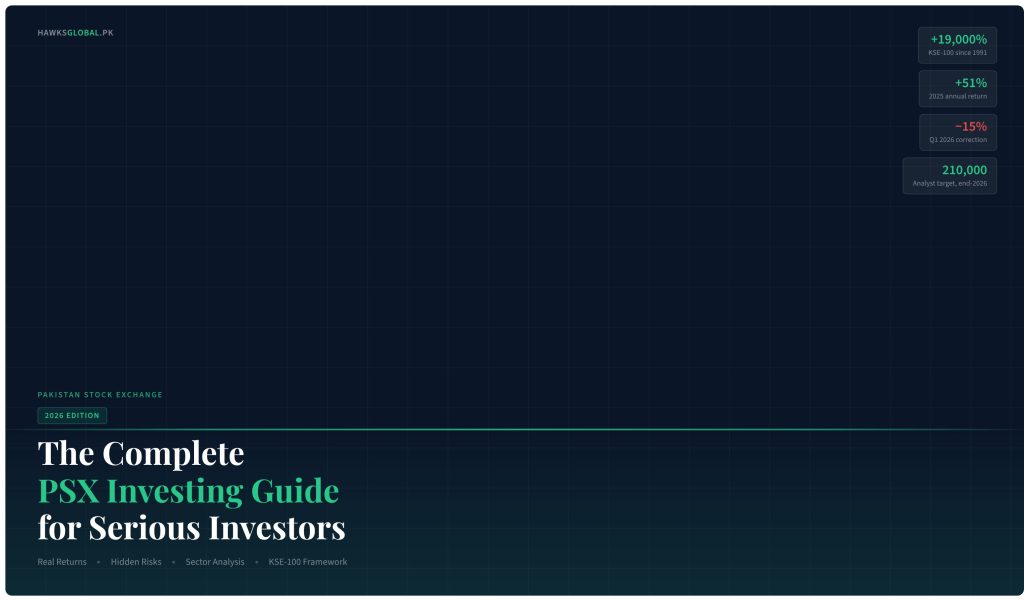
That is a 19,000% increase over 35 years.
Yet most Pakistanis with money to invest have never bought a single share on the PSX. And many who have entered the market ended their decade with less real wealth than they started — even as the index kept climbing.
Something is broken — not in the market, but in how people understand it.
This guide is going to fix that. Not with generic advice you have read a hundred times. With the kind of clear, honest, occasionally uncomfortable perspective that turns confused observers into confident, purposeful investors.
Let’s begin.
What Is the PSX Stock Market — Really?
The Pakistan Stock Exchange (PSX) is the marketplace where shares of Pakistan’s publicly listed companies are bought and sold. Think of it as an organised auction that runs every business day — one where thousands of buyers and sellers continuously negotiate prices for pieces of real businesses.
It was formed in January 2016 through the merger of the Karachi Stock Exchange, Lahore Stock Exchange, and Islamabad Stock Exchange — bringing Pakistan’s fragmented regional exchanges under one unified national bourse, regulated by the Securities and Exchange Commission of Pakistan (SECP).
As of early 2026, the PSX lists 561 companies across more than 35 sectors, with a total market capitalisation of approximately PKR 18–20 trillion (roughly $64–70 billion USD). It operates through the Karachi Automated Trading System (KATS), with share ownership held electronically through the Central Depository Company (CDC) and trades settled through the National Clearing Company of Pakistan (NCCPL).
In February 2026, PSX moved to a T+1 settlement system — meaning trades now settle in just one business day, putting Pakistan in line with some of the world’s most advanced exchanges. That is a meaningful upgrade.
The Numbers That Define PSX Right Now (April 2026)
Before diving into strategy and insight, here is your factual grounding. These figures are your foundation — the rest of this PSX investing guide explains what they actually mean for your portfolio decisions in 2026.
| Metric | Figure |
|---|---|
| Listed companies | 561 |
| Market cap | ~PKR 18–20 trillion (~$64–70B USD) |
| KSE-100 all-time high | ~191,000 points (Jan 2026) |
| KSE-100 (April 2026) | ~150,000–151,000 points |
| 12-month return (KSE-100) | +26.6% (despite Q1 correction) |
| 2025 annual return | +51% — one of world’s best performing markets |
| Total registered investors | ~500,000 (growing at 10,000–15,000/month) |
| Bloomberg ranking 2023/24/25 | Top-performing global market, 3 consecutive years |
| Broker consensus KSE-100 target | ~210,000 (end 2026) |
These numbers tell a story. But the story behind the numbers is even more important.
Pakistan vs. Bangladesh vs. Sri Lanka: The Comparison You Need to See
To understand what this PSX investing guide is working with, it helps to compare Pakistan’s market honestly with regional peers. You may have heard that Bangladesh or Sri Lanka have more active stock market investors than Pakistan. Let’s look at the actual data — because the reality is very different from the rumour.
Bangladesh (Dhaka Stock Exchange)
Bangladesh’s stock market peaked at 2.92 million beneficiary owner (BO) accounts in 2016. Since then, it has been in sustained decline. By end-2024, active accounts had fallen to approximately 1.67 million — a drop of over 1.2 million investors in eight years. In 2025 alone, market volatility and loss of confidence pushed investors to empty 66,500+ accounts. The DSEX index fell 16.5% in 2024, its worst annual performance in four years.
Bangladesh’s stock market is not a model to envy right now — it is a cautionary tale of what happens when retail confidence collapses.
Sri Lanka (Colombo Stock Exchange)
Sri Lanka’s CSE has only 284 listed companies — barely half of Pakistan’s 561. The market is small, illiquid, and emerging from an IMF debt crisis. Its market capitalisation hit an all-time high of $21.7 billion in June 2025 — a fraction of PSX’s PKR 20 trillion. There is no credible data suggesting Sri Lanka has 5 million investors. It is a significantly smaller, less developed capital market than Pakistan’s.
Pakistan (PSX)
PSX now has approximately 500,000 registered investors, growing at 10,000–15,000 new accounts per month. In 2025 alone, 120,000 new investors entered the market — a 37% expansion in the investor base in a single year. Total market cap grew by PKR 5,566 billion in 2025.
Pakistan’s PSX is not behind Bangladesh or Sri Lanka. It is growing faster, from a larger base, with stronger fundamentals. The comparison most people make is based on outdated or inaccurate information.
But here is the honest mirror: 500,000 investors in a country of 240 million people is still only 0.2% of the population. India has over 100 million registered investors. Pakistan’s retail participation gap is enormous — and closing it is the single biggest structural opportunity for PSX’s next decade.
If you are looking to understand the real wealth-building opportunities in Pakistan beyond just stocks, read our analysis of Stock Market vs. Real Estate vs. Gold in Pakistan — the comparison might surprise you.
How PSX Actually Works — The Mechanics Every Investor Needs to Know
The Trading Day
PSX is open Monday through Friday, 9:30 AM to 3:30 PM Pakistan Standard Time. During these hours, buyers and sellers submit orders through SECP-registered brokers. The system operates on an order-driven basis — no one gets a private deal. Every price is determined by supply and demand, transparently, in real time.
Placing a Trade — Step by Step
- Open an account with a registered broker (Munir Khanani securities, Arif Habib, AKD Securities, Topline, Ktrade, JS Global, and 400+ others)
- Complete KYC — your CNIC, bank details, and basic financial information
- Your broker opens a CDC account in your name — this is your digital share safe
- Fund your trading account
- Submit buy/sell orders through the broker’s platform, app, or directly online
- Settlement occurs on T+1 — shares transfer within one business day
For Overseas Pakistanis
Non-Resident Pakistanis (NRPs) can invest through Roshan Digital Accounts — the State Bank of Pakistan’s flagship financial inclusion programme available through major Pakistani banks. No need to be physically present in Pakistan.
If you are an overseas Pakistani considering PSX investment, our detailed guide on How Overseas Pakistanis Can Invest in PSX walks you through every step.
The Indices: What You Are Actually Measuring
PSX runs 11 indices, but three matter most to anyone following a serious PSX investing guide:
KSE-100 Index — The benchmark. Tracks Pakistan’s 100 largest companies by market capitalisation, with sector representation to ensure diversity. This is the number every financial news channel reports. It currently sits around 150,000 — down from its 191,000 all-time high, but still over 26% above year-ago levels.
KSE-30 Index — Tracks the 30 most liquid stocks by traded value. More volatile, more sensitive to short-term flows. Preferred by active traders.
KMI-30 Index — Tracks 30 Shariah-compliant stocks. As Pakistan’s Islamic banking sector grows, this index is becoming increasingly relevant for the majority of Pakistani investors who seek halal investing options.
The Sectors That Drive Everything
Not all sectors are equal on the PSX. Five dominate the index and the returns:
1. Commercial Banking — The Engine
Pakistan’s banks have been the single most powerful force in the KSE-100 bull run. In a high-interest-rate environment, banks earn exceptional spreads. The results were staggering: UBL’s stock surged 121–140% in a year; Meezan Bank crossed its all-time high of Rs. 505 in January 2026; MCB delivered steady 33% returns.
Key names: UBL, Meezan Bank (MEBL), MCB, HBL, Allied Bank, Bank Al-Falah
As interest rates ease in 2026, bank earnings will compress — but their structural position in Pakistan’s economy remains dominant.
2. Oil & Gas Exploration — The Heavyweights
OGDC is PSX’s largest company by market cap — touching $4 billion. Mari Petroleum and PPL complete this powerful trio. These stocks move with global crude prices and Pakistan’s domestic energy demand.
The paradox: Rising oil prices boost these companies’ revenues, but simultaneously hurt Pakistan’s current account and trigger investor fear about inflation. You can have a fundamentally profitable energy company whose stock falls because the market is afraid of broader consequences. Understanding this disconnect is essential for any serious PSX investing guide.
Key names: OGDC, Mari Petroleum, PPL
3. Fertiliser — Pakistan’s Agricultural Anchor
Pakistan’s agricultural economy is not optional — it is foundational. FFC (Fauji Fertiliser Company) reported revenue growth of 126% and profit growth of 81% with the stock rallying 140% in a single year. These are not speculative moves — they are a reflection of a business that the entire nation depends on for food production.
Key names: FFC, Engro Fertilisers (EFERT)
For investors drawn to high-dividend stocks like FFC, our guide to Dividend Investing in Pakistan for Passive Income shows exactly how to build a sustainable income-generating portfolio.
4. Cement — Infrastructure and the Long Game
Pakistan has a structural housing shortage affecting tens of millions of citizens. Those homes need cement. Lucky Cement, as the sector leader and an evolving industrial conglomerate, sits at the intersection of infrastructure demand and business diversification.
Key names: Lucky Cement, DG Khan Cement
5. Technology — The Future, Listed Today
Systems Limited (SYS) is Pakistan’s most direct listed exposure to the IT export economy. Pakistan’s IT exports have grown at double-digit rates, powered by one of the world’s highest proportions of STEM graduates and a cost-competitive labour market.
Key name: Systems Limited (SYS)
Hidden Truth #1: The PSX Bull Run Was Partly a Story of Blocked Alternatives
Between 2023 and early 2026, the KSE-100 rose from ~41,000 to 191,000 — a 365% gain. The mainstream explanation: “Pakistan’s economy recovered.”
That is partly true. But there is a less-discussed reason.
The government, through policy, blocked the exits.
Dollar purchases became restricted. The FBR crackdown and revaluation of property rates made real estate riskier to park capital in. High-denomination prize bonds were discontinued. Crypto remained legally ambiguous. Gold stayed illiquid for institutions.
Where does institutional money go when all these alternatives close? The stock market.
This is critical for 2026 reasoning. As these alternatives gradually reopen — as the rupee stabilises, as crypto regulation clarifies, as real estate normalises — some of that capital will flow back. The savvy investor identifies which companies they own because of genuine business quality, not just because PSX was “the last investment standing.”
This is exactly why comparing PSX to real estate and gold matters. See our data-backed analysis: Stock Market vs. Real Estate vs. Gold in Pakistan.
Hidden Truth #2: The “Low P/E” Story Is Seductive — And Partially a Trap
The most repeated line about PSX in 2025: “Pakistan trades at a P/E of just 6x. It is incredibly cheap!”
True. But incomplete in three important ways.
First, a low P/E in an unstable frontier market reflects real risk — currency depreciation, political volatility, governance concerns. Pakistan deserves a discount to Singapore or South Korea. The question is not “is it cheap?” but “is it cheap enough given the real risks?”
Second, PSX’s earnings have been artificially elevated by two factors now unwinding — very high interest rates (giving banks extraordinary spreads) and a weak rupee (inflating PKR earnings of exporters). As rates fall and the rupee stabilises, the “E” in the P/E equation shrinks. A stock that looks cheap at 6x today can look expensive at 9x if earnings compress 30%.
Third, the market-wide P/E of ~6x is an average dominated by cheap banking and energy stocks. Many smaller-cap stocks within PSX trade at 15–20x with poor liquidity and thin governance. The aggregate masks enormous dispersion.
The lesson: “Low P/E” begins your analysis. It should never end it.
Hidden Truth #3: Most PSX Investors Do Not Actually Earn What the Market Returns
Here is a number that should genuinely disturb you. The KSE-100 went up 19,000% over 35 years. Yet most individual investors who participated in PSX during this period earned a fraction of that return. Every honest PSX investing guide must address this gap. Why does it happen? Three reasons that compound each other:
The Rupee Illusion Trap: A 40% stock gain in a year where the rupee falls 20% and inflation runs 15% is not a 40% gain in real terms. It is roughly a 10–12% real gain. Nominal returns in PKR can look spectacular while real purchasing power grows slowly. Investors who track only their PKR portfolio value are systematically fooled.
The Crowded Consensus Collapse: Every sector on the PSX has gone through the same five-stage cycle — early discovery by smart money, mainstream validation, crowded buying by everyone, unanimous consensus, then sudden collapse. Banking stocks in early 2026, fertiliser in 2024, cement in 2022. The investor who arrives in Stage 4, when “everyone knows” the story, consistently buys near the top and sells near the bottom.
Behavioural bias loop: Academic research on Pakistani retail investors confirms that anchoring, overconfidence, and herding are statistically significant drivers of PSX investment decisions. Investors anchor to their purchase price, overestimate their skill during bull markets, and herd behind institutional momentum — buying after institutions have already bought at higher prices, and selling after institutions have already sold at lower prices.
Framework: The 4-Question Entry Rule
Before buying any PSX stock, answer these four questions slowly and honestly:
1. Is my thesis original or consensus?
If every broker report, every WhatsApp group, and every financial news channel is bullish on this stock — you are in Stage 4 of the Crowded Consensus Collapse. The best entries are always slightly uncomfortable.
2. What is my real, rupee-adjusted return target?
Not “what does the analyst say the target price is.” What inflation-adjusted, currency-risk-adjusted return does this investment need to deliver to justify the risk? And is this specific business capable of generating that?
3. What breaks my thesis — and how fast would I know?
A bank thesis breaks if rates rise. A fertiliser thesis breaks if gas supply is curtailed. A tech thesis breaks if IT export growth stalls. Define your exit conditions before you enter. The investor who decides when to sell before they buy is far more disciplined than one who decides under market pressure.
4. Can I survive being wrong for 24 months?
The PSX has a consistent pattern of punishing correct long-term theses with multi-year periods of underperformance before vindication. If being wrong for two years means financial hardship, your position size is too large for your actual situation.
The Contrarian View: “Invest for the Long Term” Is Dangerous Advice
Wait — is not long-term investing the gold standard?
Yes. But with a caveat almost no financial advisor in Pakistan will tell you:
“Invest for the long term” is only good advice if you own the right businesses.
The PSX has listed hundreds of companies over decades. Many have gone bankrupt, been de-listed, suspended trading permanently, or simply destroyed value while the index rose. Investors who held these companies “for the long term” were not rewarded — they were ruined.
Research on PSX retail outcomes is stark. One investor randomly selecting a PSX stock lost Rs. 436,000 from a Rs. 1 million investment in a single year. Another, choosing carefully, gained Rs. 3.5 million from the same starting amount. Same market. Same year. Dramatically different outcomes.
The complete version of the advice is: “Invest in exceptional businesses at reasonable prices for the long term — and be ruthlessly selective about what qualifies as exceptional.”
Most people hear only the first half. The second half is where the actual work happens.
The 500,000 Investor Milestone — What It Actually Means
Pakistan’s PSX hit approximately 500,000 registered investors in early 2026, growing at 10,000–15,000 new accounts per month. The 2025 expansion of 120,000 new investors represented a 37% growth in a single year.
This sounds impressive. And it genuinely is — as a rate of growth. But 500,000 investors in a country of 240 million people is still only 0.2% of the population. Compare:
- India: Over 100 million registered investors (~7% of population)
- South Korea: ~14 million accounts (~27% of population)
- Bangladesh: ~1.6 million accounts (declining) — and their market is struggling, not thriving
Pakistan’s retail participation gap is not an embarrassment. It is the single largest structural opportunity in the PSX story.
Here is the second-order thinking most investors miss: if Pakistan’s investor base grows from 500,000 to even 5 million over the next decade — still less than 2% of the population — the structural demand for equities would be transformative. That inflow of new domestic capital would support higher valuations, greater liquidity, and stronger long-term returns for investors who positioned early.
The investors building PSX portfolios today are not just betting on individual companies. They are betting on the structural deepening of Pakistan’s entire capital market ecosystem. That is a decades-long compounding story.
For professionals — doctors, lawyers, engineers — who have not yet entered the PSX, our guide How Doctors in Pakistan Can Grow Wealth with PSX shows a practical, risk-managed approach to beginning.
The Q1 2026 Correction: What Happened and Why It Matters
After reaching ~191,000 points in January 2026, the KSE-100 entered one of its sharpest corrections in recent years — falling approximately 15% in Q1 2026. March alone saw the index drop 19,319 points, which is 11.5% in a single month.
The causes:
- Global oil shock — Crude benchmarks surged above $100/barrel, peaking near $135. For import-dependent Pakistan, this is a direct threat to the current account, inflation, and fiscal stability.
- Geopolitical escalation — Regional tensions rattled frontier and emerging market investors globally.
- Profit-taking — After three consecutive years of extraordinary gains, institutional investors took profits. This is not panic — it is rational.
- Foreign outflows — International portfolio investors reduced frontier market exposure amid global risk-off conditions.
The 15 major brokerage houses covering 78 PSX stocks have a consensus KSE-100 target of approximately 210,000 points by end-2026 — representing roughly 40% upside from current levels. That is an analyst target, not a guarantee. But it reflects a professional community that sees genuine value in PSX companies at current prices — particularly in banking, fertiliser, and energy.
The Long-Term Lens: PSX in 2036
If you extend your thinking to a decade, the PSX story becomes genuinely compelling — but only if you understand its structural evolution.
The participation explosion: PSX’s financial literacy programs, digital brokerage apps, Urdu-language investment resources, and the Roshan Digital Account ecosystem are each pulling new investors in. The trend is not slowing — it is accelerating.
The demographic dividend: Pakistan has one of the world’s youngest populations. As this cohort enters formal employment, earns, saves, and invests — the pool of domestic capital flowing into PSX equities will grow structurally. This is demography, not speculation.
The formalisation effect: As Pakistan’s economy formalises — more businesses in the documented sector, more tax compliance, more institutional structures — the listed universe on PSX will expand. New sectors including tech, renewable energy, healthcare, and fintech will IPO. The PSX of 2036 will look dramatically different from today’s.
Two Mental Models Every PSX Investor Should Carry
Mental Model 1 — The Toll Booth, Not the Lottery
Most retail investors approach PSX like a lottery — one concentrated bet on a massive, life-changing win. This mindset causes: taking oversized positions in speculative names, chasing momentum, selling winners too early, holding losers forever.
The superior mental model is a toll booth. A toll booth generates small, consistent, predictable income from a high-traffic asset. FFC collecting fertiliser demand from Pakistan’s agricultural economy every single year. OGDC collecting income from Pakistan’s structural energy deficit. Meezan Bank collecting the margin on Pakistan’s inevitable shift toward Islamic finance.
These are not exciting cocktail party stories. But compounded over a decade with dividends reinvested, they build serious, durable wealth.
Dividend reinvestment is the silent compounder most investors disable by spending their payouts. Our guide to Dividend Investing in Pakistan for Passive Income shows exactly how the reinvestment math compounds over time.
Mental Model 2 — The Reservoir, Not the River
Markets do not flow continuously upward. They accumulate sideways for long periods, frustrating impatient investors into selling. Then they release — dramatically, rapidly — rewarding those who stayed.
The investors who captured the 2023–2025 bull run were those who remained invested through the painful 2021–2022 bear market. Knowing you are sitting next to a reservoir does not tell you when it overflows. But it tells you why you should not walk away just because the water level has not moved lately.
Practical PSX Investing Guide: Building Your First Portfolio Step by Step
Rather than picking a single stock and hoping, use a structured allocation:
Core — 50 to 60% of your equity allocation
Blue-chip, high-dividend companies with proven business models — OGDC, FFC, UBL, MCB. These provide stability, income, and track records through multiple economic cycles.
Growth — 25 to 35%
Higher-upside plays with strong fundamentals — Meezan Bank, Systems Limited, Lucky Cement, Mari Petroleum. More volatile, but with meaningful long-term upside.
Speculative — 10 to 15%
Smaller positions in higher-risk opportunities you have genuinely researched — not just heard about in a WhatsApp group.
For most new investors, dollar-cost averaging is the right tactical approach — investing a fixed amount monthly regardless of market level. It removes the paralysing question of “is this the right time?” and replaces it with a system that works through full market cycles.
Tax and Compliance — What PSX Investors Need to Know
All PSX investment returns are subject to Pakistan’s tax regime. Capital gains tax rates depend on your holding period — longer holds are taxed at lower rates, incentivising the patient, long-term approach that builds real wealth.
Dividend income from PSX companies is subject to withholding tax, which brokers deduct at source.
Critically: Whether you earn Rs. 1,000 in dividends or Rs. 10 million in capital gains, you are required to file a tax return. Being a non-filer in Pakistan carries both financial penalties and restrictions that can affect your investing activity. Verify your filer status anytime on the FBR IRIS portal before making investment decisions.
For full guidance on tax obligations for PSX investors, read our detailed article: How to File a Tax Return in Pakistan — including what investment income you must declare.
Frequently Asked Questions
The questions below are the ones readers of this PSX investing guide ask most often — answered directly and honestly.
What is the PSX and how is it different from the KSE-100?
PSX (Pakistan Stock Exchange) is the exchange itself — the institution, the platform, the regulated marketplace. The KSE-100 is an index — a measurement tool that tracks the performance of the 100 largest listed companies. When people say “the market is up 500 points today,” they mean the KSE-100 index moved.
What are PSX trading hours?
Monday to Friday, 9:30 AM to 3:30 PM Pakistan Standard Time. The pre-open session begins at 9:15 AM.
How much money do I need to start investing in PSX?
There is no legal minimum. Practically, most brokers suggest starting with at least PKR 10,000–25,000 to make transaction costs meaningful relative to your investment.
Can overseas Pakistanis invest in PSX?
Yes — through Roshan Digital Accounts offered by major Pakistani banks. No physical presence in Pakistan required.
Is PSX halal? Can I invest in Shariah-compliant stocks?
Yes. The KMI-30 Index tracks 30 Shariah-compliant stocks. The PSX-KMI All Shares Index is broader. Meezan Bank, for example, is a full Islamic bank. SECP and PSX both provide guidelines for halal investing.
Is PSX safe?
PSX is a regulated exchange under SECP oversight. The structural risk is market risk — prices going up and down — not the risk of the exchange itself collapsing. Your shares are held electronically by the CDC, independent of your broker. Even if a brokerage fails, your shares remain yours.
What happened to the PSX in Q1 2026?
The KSE-100 fell approximately 15% in Q1 2026 due to surging global oil prices above $100/barrel, geopolitical escalation, and profit-taking after three years of extraordinary gains. The index remains over 26% above year-ago levels despite the correction.
Is the PSX correction a buying opportunity?
Analyst consensus from 15 major brokerages targets the KSE-100 at ~210,000 by end-2026 — implying ~40% upside from current levels. The honest answer: no one knows the exact bottom. But for investors with a 3–5 year horizon and quality companies, the risk-reward is more favourable after a 15% correction than before it.
The Question That Should Make You Uncomfortable
Here is the one most investors avoid.
“If I remove the bull market of 2023–2025 from my track record, what do my investing results actually look like?”
For most PSX retail investors, the honest answer is: not great.
They made money because almost everything went up. The rising tide lifted most boats. Confidence grew. Position sizes grew. Then Q1 2026 arrived.
A rising market is an extremely poor test of investing skill. It rewards participation and punishes caution — regardless of whether the participation was informed or reckless.
The real test is not what you made in the bull market. It is what you kept in the correction. And whether the companies you hold today have the earnings power, the balance sheet strength, and the business durability to grow through whatever comes next.
If sitting with that question makes you slightly uncomfortable — that is the point. Awareness that stings is worth more than confidence that soothes.
Final Word: Pakistan’s Market, Pakistan’s Moment
This PSX investing guide was written for investors who want to think clearly — not for those who want to be told what to buy.
The PSX is real. The wealth it creates is real. The bull case for Pakistan’s trajectory — 240 million people, one of the world’s youngest populations, an expanding middle class, a deepening financial system, robust corporate earnings in key sectors — is real.
But the PSX does not reward passive participation. It rewards structured thinking, emotional discipline, awareness of your own biases, and a framework for making decisions that accounts for what you do not know as much as what you do.
The investors who will compound real wealth through the PSX over the next decade are not those with the best WhatsApp stock tips. They are the ones who understand they are playing a long game of informed patience — against a crowd of emotional reactors — and who build their process accordingly.
That edge is available to you right now. All you have to do is use it.
Related Reading on HawksGlobal
- How Overseas Pakistanis Can Invest in PSX — Step-by-Step Guide
- Dividend Investing in Pakistan: Build Passive Income from PSX
- Stock Market vs. Real Estate vs. Gold in Pakistan — The Data-Backed Answer
- How Doctors in Pakistan Can Grow Wealth with PSX
- How to File a Tax Return in Pakistan — For PSX Investors
This article is for educational and informational purposes only. It does not constitute investment advice. All investments carry risk, including the potential loss of principal. Consult a SECP-registered financial advisor before making investment decisions. Past performance does not guarantee future results.